Ulli Diemer — Radical Digressions
Blogs & Notes
Articles Lists
- Selected Articles
- Articles in English
- Articles in German
- Articles in French
- Articles in Spanish
- Articles in Other Languages
- All Articles A-Z
- Subject Index
Compilations & Resources

Bathurst Heights Yearbooks
1966 - 1967 - 1968

|

|

|
Bathurst Heights (Official name: Bathurst Heights Secondary School and Collegiate Institute) was a high school which opened its doors in 1951 in what was then the Toronto suburb (‘borough’) of North York. It closed its doors as a regular operating school in 2001. The building at 640 Lawrence Avenue West has been used subsequently for various educational purposes.
Digitized issues of the Bathurst Heights yearbooks (the Phoenix) for the years 1966, 1967, 1968 are available on this website, in both PDF and HTML formats.
More Bathurst: Classmates.com has a Bathurst Heights section, but you can’t see much without paying. Facebook has a Bathurst Heights group, but it can go for months without new postings.
A note from Ulli Diemer:
Historical research and archiving have been a big part of my life, so it was probably predictable that I would decide to scan my high school yearbooks and put them online. Here they are!
It is my impression that many – most? – people quickly put their high school experiences and friendships behind them when they graduate and set about shaping their adult lives and identities. I have been one of those who has maintained more of a connection, not with the school itself, but with a few people – more than a handful, actually – from high school. I can’t say that has been deliberate; mostly it has been the result of life’s twists and turns which look like mere accidents when seen from one angle, but which, seen from another angle, seem not-so-accidental. In any case, it’s amusing to count up the number of people I know who also went to Bathurst Heights. And while there are a handful whom I have known for more than 50 years, in many cases, I didn’t meet them until after I left Bathurst.
There is actually a simple explanation for that: my partner Miriam also went to Bathurst Heights, a few years after me. She was a social connector, as outgoing as I was shy, so once we got together, I was plunged into a world of connections, quite a few of which led to Bathurst. Sisters-in-law who went to Bathurst Heights, camp counsellors and ex-boyfriends who remained friends, political collaborators, medical colleagues, hockey teammates, and people we’d run into at weddings, bar mitzvahs, and shivas. I recall Simon saying on one occasion, somewhat awestruck, “My Mom knows everybody.”
In the past few years, I have been doing oral history interviews, and that has sharpened my interest in learning how people’s lives unfold. I am interested in beginnings, and in the interviews we often go back to their high school years: that time of adolescent turmoil when everything was changing, when they were still in the structured environment of school and the parental home, but getting ready to make a leap into the wider world of adulthood and an unknown future. I also find myself thinking about people I knew in high school, the people I didn’t keep in touch with, wondering how their lives unfolded, what they are doing now, and who they are now. Sometimes someone gets in touch (I’m not hard to find, since I seem to be the only Ulli Diemer in the world), and I’m always really interested to hear something of the story of their lives.
When I first started oral history interviews, to which I brought my experience of doing interviews as a journalist, I used to compile an organized list of questions in the way I had done in journalism. Eventually I drifted away from doing that. I’m older and lazier now, so typically I just ask one question: “Tell me how you got to be who you are.” And then I listen to their story, which I always find fascinating.
If you are one of those who I knew at Bathurst, feel free to get in touch. I’d like to know who you are now, and how you got to be who you are. I could even tell you how I got to be who I am – though in truth who I am seems to keep changing.
Ulli Diemer
mailroom@diemer.ca
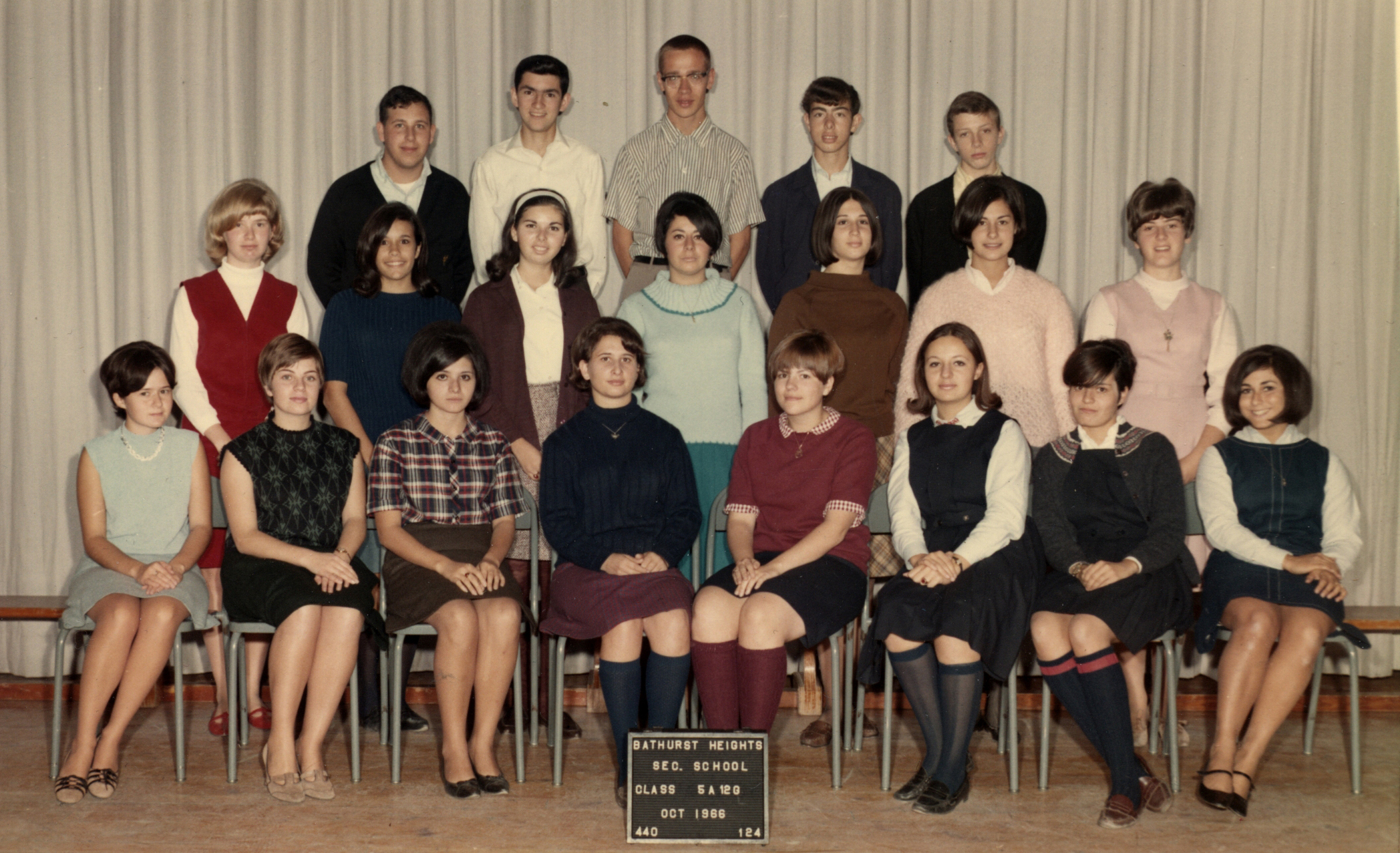
Bathurst Heights: my Grade 12 class, 1966-1967.
A few of my interviews and personal scribblings
Here are a few items which deal with memories and their importance in our lives.
Collective Memory, Archives, and Connexions: Michael Riordon interviews Ulli Diemer
Don Weitz in conversation with Ulli Diemer
Johl Whiteduck Ringuette in conversation with Ulli Diemer
Joy Kogawa in conversation with Ulli Diemer
Thinking about Terry Fox and the Marathon of Hope
Moments with Miriam (PDF). There is also an interactive HTML version here.
Special Places: Photography and the Landscape of Memory
This content is provided free of charge for non-commercial purposes. It may be used for research and educational purposes, as well as for private study, under the ‘fair dealings’ provisions of Canadian copyright law.